

If you’re searching for real answers about retinoids long term effects, you’re likely weighing the promise of smoother, clearer, more youthful-looking skin against concerns about irritation, thinning, or sensitivity over time. With so much conflicting advice online, it’s hard to know what’s evidence-based and what’s just skincare hype.
This article breaks down exactly what happens when retinoids are used consistently over months and years—covering benefits, potential side effects, skin barrier impact, and how to use them safely for lasting results. You’ll learn who benefits most, who should be cautious, and how to build a routine that supports long-term skin health rather than compromising it.
Our insights are grounded in dermatological research, clinical studies on vitamin A derivatives, and real-world skincare application strategies. By the end, you’ll have a clear, balanced understanding of what long-term retinoid use truly means for your skin—and how to make the smartest choice for your glow.
Retinoids are the undisputed gold standard in dermatology, backed by decades of peer-reviewed research showing they stimulate collagen, accelerate cell turnover, and reduce fine lines (American Academy of Dermatology). In the short term, users may see purging, peeling, and sensitivity; however, the real story unfolds over years. After five to ten years of consistent use, skin typically appears firmer, more even-toned, and smoother. At twenty years, collagen preservation can mean fewer wrinkles and improved elasticity. Still, critics question retinoids long term effects, citing irritation risks. Yet, with sunscreen and gradual dosing, benefits outweigh drawbacks, making it a marathon worth running.
The Compounding Rewards: How Your Skin Improves Over Decades
Sustained Collagen Production
Retinoids work by stimulating fibroblasts—the cells responsible for producing collagen, the structural protein that keeps skin firm and elastic. With consistent use over years, this stimulation becomes cumulative. Think of it like compound interest for your face (only far more visible). Clinical studies show topical retinoids increase collagen synthesis and reduce collagen breakdown, improving dermal density over time (American Academy of Dermatology). The benefit isn’t a short-term “plump”—it’s structural reinforcement that supports smoother, firmer skin well into later decades.
Permanent Texture Refinement
Retinoids normalize cellular turnover, meaning skin sheds and renews itself at a balanced, predictable rate. Once this becomes your baseline, texture stays consistently refined. Pores appear smaller because debris is less likely to accumulate, and established fine lines gradually soften as surface irregularities even out. In other words, retinoids long term effects reshape how your skin behaves, not just how it looks on a given day.
- Smoother surface feel
- Reduced wrinkle depth
- More uniform pore appearance
(Pro tip: Consistency beats concentration—steady use often outperforms cycling high strengths.)
Long-Term Pigmentation Control
By regulating melanocyte activity—the cells that produce pigment—retinoids fade existing hyperpigmentation and help prevent new sunspots. Research published in the Journal of Investigative Dermatology confirms their role in dispersing excess melanin. The result is a more luminous, even tone that doesn’t rely solely on corrective treatments.
A Lifetime of Clarity
Retinoids prevent microcomedones—the invisible clogged pores that evolve into acne. By keeping follicles clear, they act as a long-term maintenance plan. For acne-prone skin, that means fewer flare-ups and more predictable clarity (a welcome plot twist for anyone tired of surprise breakouts).
Navigating the Journey: Potential Concerns and Smart Mitigation
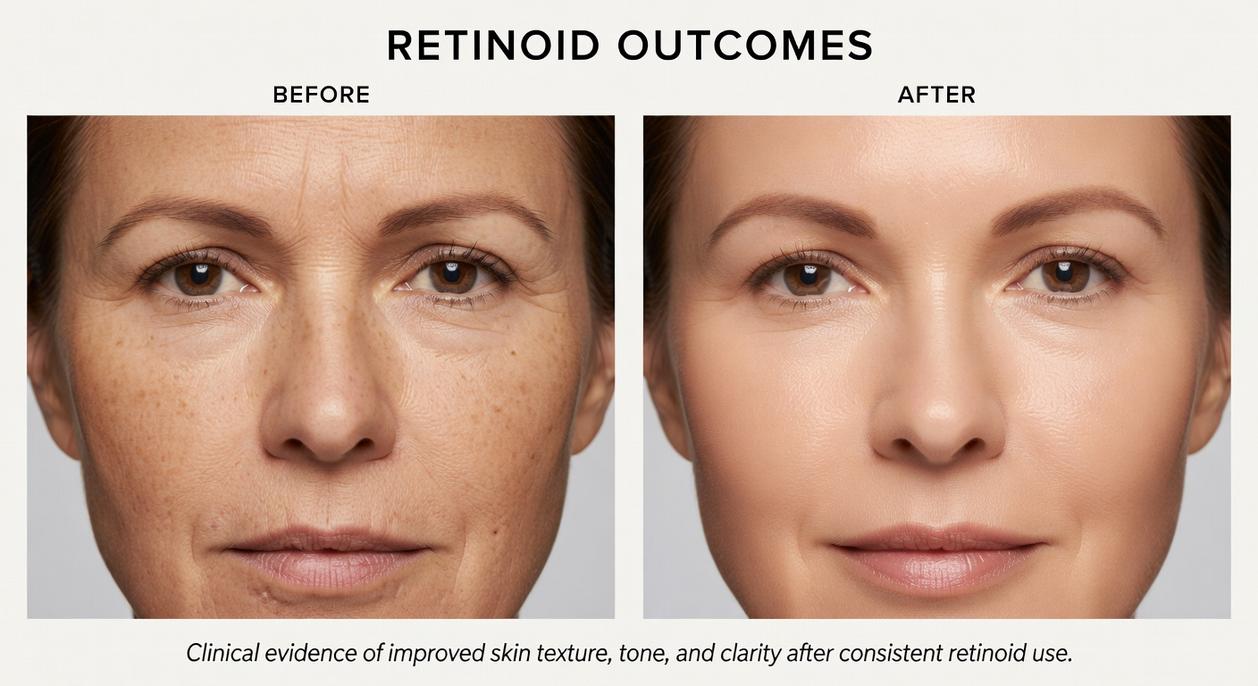
Retinoids can transform skin—but have you ever wondered what happens if you use them for years? Let’s talk honestly about retinoids long term effects and how to stay ahead of potential issues.
Chronic Dryness and Barrier Health
The most common long-term concern is a persistently compromised skin barrier—the outer defense layer that keeps moisture in and irritants out. When this barrier weakens, you may notice tightness, flaking, or stinging (the “why does everything suddenly burn?” phase).
Some argue dryness just means the product is “working.” Not quite. Chronic inflammation can undermine results. The fix? A non-negotiable support routine rich in ceramides (lipids that reinforce the barrier), fatty acids, and humectants like glycerin that draw in water. Think of it as reinforcing the bricks and mortar of your skin.
Pro tip: Apply moisturizer to slightly damp skin to improve hydration retention.
Permanent Sun Sensitivity
Here’s a truth many gloss over: increased photosensitivity isn’t temporary. It lasts as long as you use retinoids. Are you applying broad-spectrum SPF 30+ every single morning—even when it’s cloudy? Sunscreen isn’t optional; it’s inseparable from your routine. UV damage can undo collagen gains (yes, really—see American Academy of Dermatology guidance).
The “Skin Thinning” Myth vs. Reality
Worried retinoids thin your skin? That fear is common—and misleading. Retinoids thin the stratum corneum (the outermost dead layer), which boosts glow. At the same time, they thicken the deeper dermis by stimulating collagen production (Journal of Investigative Dermatology). Net effect? Stronger, more resilient skin.
Eye Area Considerations
Do you apply product too close to your lash line? Migration into the eyes may contribute to dryness and even Meibomian Gland Dysfunction (MGD), which affects tear stability. Create a “buffer zone” with an occlusive balm and never apply retinoid directly to eyelids.
Supporting ingredients like those discussed in breaking down niacinamide benefits for different skin concerns can further reinforce resilience. Smart strategy beats fear—every time.
Your Long-Term Strategy: Adapting Retinoid Use Through the Decades
When it comes to retinoids, strength is flashy, but consistency is what actually changes skin. A higher percentage doesn’t automatically mean better results. In fact, using a tolerable formula five nights a week often outperforms a stronger one you can barely handle twice a week. Dermatology research consistently shows that adherence drives outcomes more than potency (American Academy of Dermatology). So before jumping from 0.025% to 0.1%, ask yourself: is your skin thriving—or just surviving?
That said, I’ll admit there’s debate about when to increase strength. Some experts argue that after years of stable use, a gradual step up can enhance collagen stimulation. Others believe steady use at a moderate level delivers comparable retinoids long term effects without added irritation. The truth is, we don’t have perfect, one-size-fits-all data. Your skin’s response matters more than the label.
This is where “retinoid cycling” comes in. Think of it as strategic recovery—reducing application from nightly to three times weekly during winter, travel, or high stress. Skin barriers weaken under environmental strain (Journal of Investigative Dermatology), and temporary scaling back can prevent inflammation before it spirals.
Meanwhile, build a supportive routine. Use vitamin C in the morning to neutralize free radicals and complement nighttime renewal. Pair retinoids with niacinamide for barrier support and peptides for resilience. Together, they act like a well-balanced team (no superhero works alone).
Above all, listen closely. Tightness, subtle stinging, or increased redness are early whispers. Adjust early, and your skin will thank you decades from now.
A Future-Proof Glow
The long-term evidence overwhelmingly shows that consistent, intelligent retinoid use creates significant, positive, and lasting improvements in skin health and appearance. Concerns about retinoids long term effects are valid—but manageable with guidance and patience.
Think beyond the tube.
- Pair it with daily sunscreen, barrier-repair moisturizers, and seasonal adjustments.
What’s next? Track your progress, reassess strength, and ask how your routine will evolve in five, ten, twenty years. Retinoids work best as one pillar in a comprehensive, adaptive strategy for radiant skin for decades to come. Commit now, and your future complexion will thank you. Start thoughtfully today.
Your Glow Strategy Starts Now
You came here looking for clarity on how to build a smarter, safer beauty routine—and now you have it. From understanding ingredient balance to navigating retinoids long term effects, you’re better equipped to protect your skin barrier, boost radiance, and avoid the frustration of irritation, breakouts, or wasted products.
The truth is, most glow setbacks happen when routines are rushed or trends are followed blindly. Inconsistent results, sensitivity flare-ups, and dull skin aren’t random—they’re signs your foundation needs refining. When you take a holistic approach—pairing advanced formulations with barrier support and everyday beauty hacks—you create results that actually last.
Now it’s your move. Audit your current routine. Remove what’s overwhelming your skin. Add targeted, proven formulations that support long-term glow—not just short-term shine.
If you’re ready to stop guessing and start seeing visible, healthy radiance, explore our expert-backed beauty insights and glow strategies trusted by thousands seeking smarter skincare solutions. Your skin deserves a plan that works—start building it today.
 Founder & Creative Director
There is a specific skill involved in explaining something clearly — one that is completely separate from actually knowing the subject. Norvain Tavender has both. They has spent years working with everyday beauty hacks in a hands-on capacity, and an equal amount of time figuring out how to translate that experience into writing that people with different backgrounds can actually absorb and use.
Norvain tends to approach complex subjects — Everyday Beauty Hacks, Insight Influx, Advanced Makeup Formulations being good examples — by starting with what the reader already knows, then building outward from there rather than dropping them in the deep end. It sounds like a small thing. In practice it makes a significant difference in whether someone finishes the article or abandons it halfway through. They is also good at knowing when to stop — a surprisingly underrated skill. Some writers bury useful information under so many caveats and qualifications that the point disappears. Norvain knows where the point is and gets there without too many detours.
The practical effect of all this is that people who read Norvain's work tend to come away actually capable of doing something with it. Not just vaguely informed — actually capable. For a writer working in everyday beauty hacks, that is probably the best possible outcome, and it's the standard Norvain holds they's own work to.
Founder & Creative Director
There is a specific skill involved in explaining something clearly — one that is completely separate from actually knowing the subject. Norvain Tavender has both. They has spent years working with everyday beauty hacks in a hands-on capacity, and an equal amount of time figuring out how to translate that experience into writing that people with different backgrounds can actually absorb and use.
Norvain tends to approach complex subjects — Everyday Beauty Hacks, Insight Influx, Advanced Makeup Formulations being good examples — by starting with what the reader already knows, then building outward from there rather than dropping them in the deep end. It sounds like a small thing. In practice it makes a significant difference in whether someone finishes the article or abandons it halfway through. They is also good at knowing when to stop — a surprisingly underrated skill. Some writers bury useful information under so many caveats and qualifications that the point disappears. Norvain knows where the point is and gets there without too many detours.
The practical effect of all this is that people who read Norvain's work tend to come away actually capable of doing something with it. Not just vaguely informed — actually capable. For a writer working in everyday beauty hacks, that is probably the best possible outcome, and it's the standard Norvain holds they's own work to.