
Healthy, radiant skin starts with the right foundation—but with so much conflicting advice online, it’s easy to feel overwhelmed. If you’re searching for clear, effective strategies to improve your glow, refine your skincare routine, and avoid common mistakes like over exfoliation damage, you’re in the right place. This article is designed to give you practical, science-backed guidance that actually works in real life.
We’ve analyzed current dermatological research, reviewed advanced formulation standards, and examined proven beauty techniques to ensure the insights shared here are accurate and results-driven. From building a balanced skincare routine to understanding how makeup and skin health work together, you’ll find actionable steps you can apply immediately.
Whether you’re looking to strengthen your skin barrier, enhance your natural glow, or elevate your everyday beauty routine, this guide breaks it down clearly—so you can make confident, informed decisions for your skin.
Chasing glass skin with scrubs, acids, and peels feels productive—like you’re polishing a diamond. But if your glow quest leaves you red, tight, and breaking out, the problem isn’t dull skin. It’s overdoing it.
Many assume more exfoliation equals more radiance. I recommend the opposite: PROTECT YOUR BARRIER. Foundational skincare prioritizes a healthy skin barrier—the outer layer that seals in moisture and blocks irritants (think of it as your skin’s security system). over exfoliation damage often masquerades as acne or sensitivity.
Do this:
- Pause all exfoliants for two weeks.
- Use a cleanser and moisturizer.
- Add sunscreen daily.
The Science of Shedding: How Exfoliation is Supposed to Work
Your skin is constantly renewing itself through a process called desquamation—the natural shedding of dead skin cells from the outermost layer. Roughly every 28 days (give or take, depending on age and health), fresh cells rise to the surface while old ones flake away. When this cycle runs smoothly, skin looks clear and balanced.
Exfoliation is meant to assist this process—not replace it.
There are two main types:
- Physical exfoliation: Scrubs, brushes, or textured tools that manually remove buildup.
- Chemical exfoliation: Acids like AHAs (alpha hydroxy acids), BHAs (beta hydroxy acids), and PHAs (polyhydroxy acids) that dissolve the “glue” holding dead cells together.
The goal is support, not force. Overdoing it disrupts the skin barrier—made up of the stratum corneum and the protective acid mantle—which acts as your body’s frontline defense against irritation and moisture loss.
When that barrier is compromised, over exfoliation damage can show up as redness, tightness, or breakouts (yes, the irony).
Done properly, exfoliation refines—not punishes—your skin.
Red Flags: 5 Telltale Signs You’re Exfoliating Too Much

I learned this the hard way. A few years ago, I got hooked on that squeaky-clean feeling (you know the one). I thought if a little exfoliation was good, more had to be better. Within weeks, my “glow” turned into a tight, irritated mess. That’s when I understood what over exfoliation damage really looks like.
Here are the signs to watch for:
-
Increased Sensitivity and Stinging
If products that never bothered you suddenly burn, your skin barrier (the protective outer layer that keeps irritants out and moisture in) is likely compromised. Even gentle moisturizers can feel spicy. -
A Waxy, Artificially Shiny Surface
This isn’t a hydrated glow. It’s a tight, plastic-like sheen that looks almost stretched. Healthy skin reflects light softly; over-exfoliated skin looks suspiciously polished (like it’s auditioning for a sci-fi reboot). -
Persistent Redness and Inflammation
Temporary flushing after a peel is normal. Constant redness that lingers for days is not. That’s your skin waving a white flag. -
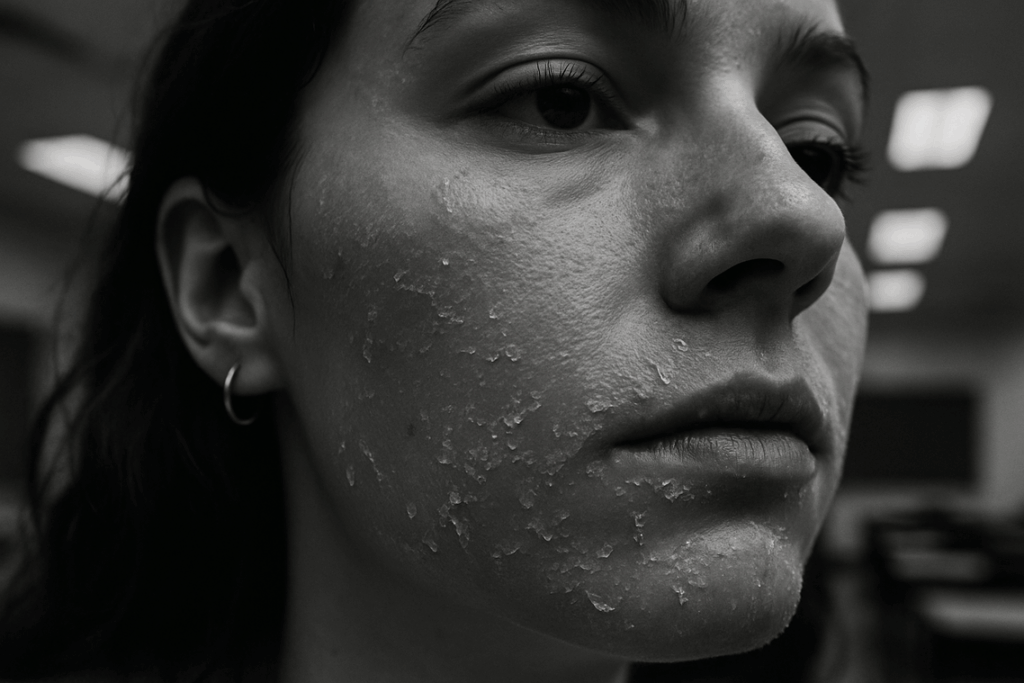
Unusual Dryness, Flaking, or Tightness
Stripping natural oils increases transepidermal water loss (TEWL), meaning water escapes from your skin faster than it should. The result? Flakes, tightness, and makeup that clings in all the wrong places. -
An Increase in Breakouts
Ironically, weakening your barrier makes it easier for acne-causing bacteria to thrive. Compromised skin is reactive, inflamed, and breakout-prone.
Some argue frequent exfoliation keeps pores clear. True—to a point. But balance matters. Supporting your barrier (think hydration and ingredients like those discussed in peptides in skincare do they really support firmness) is what keeps glow sustainable, not stripping your skin daily.
The Damage Done: What Over-Exfoliation Does to Your Skin Barrier
Healthy skin depends on its barrier function—a tightly packed layer of cells and lipids that acts like a brick wall. When you exfoliate too often, you strip away not just dead cells but the acid mantle, a thin, slightly acidic film (average pH 4.5–5.5) that keeps harmful bacteria out and moisture in. Once disrupted, your skin’s pH rises, enzymes misfire, and defense mechanisms weaken.
Physical scrubs can create microscopic tears in the surface (yes, even the “gentle” ones), while strong acids dissolve structural proteins beyond their target zone. These openings become pathways for inflammation, allergens, and irritants. The result? Redness, stinging, and unpredictable breakouts that feel like they came out of nowhere.
Over time, over exfoliation damage pushes skin into survival mode. Instead of focusing on collagen production and repair, it diverts energy toward calming chronic inflammation. A compromised barrier also increases sensitivity to UV radiation and pollution—two major drivers of premature aging. Fine lines deepen faster because hydration escapes more easily.
• Pro tip: If your products suddenly burn, pause actives for 7–10 days and prioritize barrier-repair ingredients like ceramides and cholesterol.
What’s next? You might wonder how often is safe—or how to tell if your barrier is already compromised. Look for persistent tightness, shine without oil, and delayed healing. Recovery starts with subtraction, not addition.
Your 3-Step Barrier Repair Blueprint: How to Heal Your Skin
When your skin is stinging, flaky, or suddenly breaking out, you’re likely dealing with over exfoliation damage. The fix isn’t another “miracle” product. It’s restraint. Think of this as rehab for your face (yes, skin can get hangovers too).
-
The Exfoliation Fast
Stop all exfoliating acids, scrubs, brushes, and resurfacing tools for 2–4 weeks. No exceptions. Acids like glycolic or salicylic may promise glow, but right now they’re pouring salt on a wound. Your barrier—meaning the outermost protective layer of skin—needs uninterrupted time to rebuild. -
Simplify and Soothe
Go back to basics: a gentle, pH-balanced cleanser, a hydrating serum with ceramides (lipids that reinforce your barrier), hyaluronic acid (a water-binding molecule), or niacinamide (a calming form of vitamin B3), plus a nourishing moisturizer. Daily SPF is non-negotiable. UV exposure worsens inflammation and delays healing (American Academy of Dermatology). -
Slow, Gentle Reintroduction
After healing, reintroduce a mild exfoliant like lactic acid or a PHA just 1–2 times weekly. Monitor closely.
Prediction: Skin cycling and barrier-first routines will likely dominate future skincare trends as consumers prioritize resilience over rapid resurfacing.
You were right to question your routine. That persistent redness and stinging likely trace back to over exfoliation damage, not some mysterious skin flaw. For years, the beauty world pushed the idea that more acids meant more glow. However, chasing radiance with daily scrubs and peels often weakens the skin barrier—the protective outer layer that keeps moisture in and irritants out. When that barrier breaks, irritation follows.
Instead, lasting luminosity comes from repair. Support your barrier with gentle cleansers, hydration, and patience. In the future, I predict minimalist routines will replace aggressive trends. Ready to reset today and breathe deeply?
Protect Your Glow Starting Today
You came here to understand how to protect your skin and avoid over exfoliation damage—and now you know the warning signs, the causes, and the smarter ways to exfoliate without compromising your glow. When your skin barrier is irritated, tight, or constantly breaking out, it’s not just frustrating—it’s a signal that your routine needs refinement.
The good news? Healthy, radiant skin isn’t about doing more. It’s about doing what works. By choosing balanced exfoliation methods, spacing treatments correctly, and prioritizing barrier-repair ingredients, you can restore clarity and maintain that smooth, luminous finish without setbacks.
If you’re tired of redness, sensitivity, or dullness caused by overdoing it, now is the time to reset. Discover expert-backed glow strategies and skin-barrier–safe routines designed to deliver real results without the risk. Join thousands who trust proven beauty insights to transform their skincare approach—start refining your routine today and give your skin the strength and radiance it deserves.
 Operations & Brand Strategy Manager
Richard Cortezimbra has opinions about advanced makeup formulations. Informed ones, backed by real experience — but opinions nonetheless, and they doesn't try to disguise them as neutral observation. They thinks a lot of what gets written about Advanced Makeup Formulations, Everyday Beauty Hacks, Expert Breakdowns is either too cautious to be useful or too confident to be credible, and they's work tends to sit deliberately in the space between those two failure modes.
Reading Richard's pieces, you get the sense of someone who has thought about this stuff seriously and arrived at actual conclusions — not just collected a range of perspectives and declined to pick one. That can be uncomfortable when they lands on something you disagree with. It's also why the writing is worth engaging with. Richard isn't interested in telling people what they want to hear. They is interested in telling them what they actually thinks, with enough reasoning behind it that you can push back if you want to. That kind of intellectual honesty is rarer than it should be.
What Richard is best at is the moment when a familiar topic reveals something unexpected — when the conventional wisdom turns out to be slightly off, or when a small shift in framing changes everything. They finds those moments consistently, which is why they's work tends to generate real discussion rather than just passive agreement.
Operations & Brand Strategy Manager
Richard Cortezimbra has opinions about advanced makeup formulations. Informed ones, backed by real experience — but opinions nonetheless, and they doesn't try to disguise them as neutral observation. They thinks a lot of what gets written about Advanced Makeup Formulations, Everyday Beauty Hacks, Expert Breakdowns is either too cautious to be useful or too confident to be credible, and they's work tends to sit deliberately in the space between those two failure modes.
Reading Richard's pieces, you get the sense of someone who has thought about this stuff seriously and arrived at actual conclusions — not just collected a range of perspectives and declined to pick one. That can be uncomfortable when they lands on something you disagree with. It's also why the writing is worth engaging with. Richard isn't interested in telling people what they want to hear. They is interested in telling them what they actually thinks, with enough reasoning behind it that you can push back if you want to. That kind of intellectual honesty is rarer than it should be.
What Richard is best at is the moment when a familiar topic reveals something unexpected — when the conventional wisdom turns out to be slightly off, or when a small shift in framing changes everything. They finds those moments consistently, which is why they's work tends to generate real discussion rather than just passive agreement.